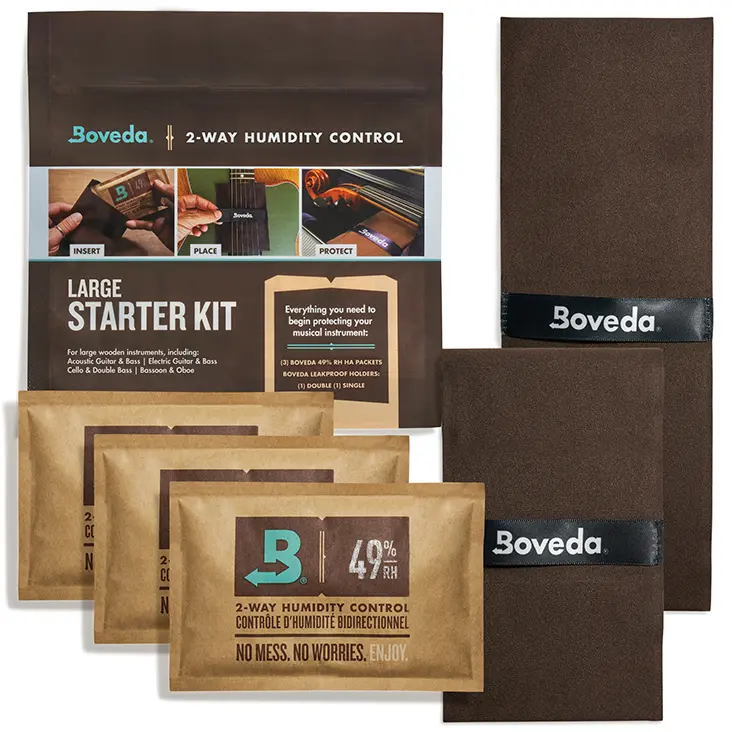




Great musicians, especially guitarists and singer-songwriters, look for instruments that will be fully faithful to the emotions they want to convey to their audience. When the right guitar does justice to the music, the resulting sound becomes part of who they are artistically. The guitar becomes a source of inspiration. For many artists, that perfect acoustic guitar is a Boucher. To keep it that way, Boucher ships every guitar with Boveda 2-way humidity packs. This unique guitar protection by Boveda automatically maintains the ideal humidity range for wood instruments.
Boucher Guitars is a Canadian guitar brand, founded in 2005 by Robin Boucher. The high-end acoustic guitars are renowned for their warm, resonant tones and use of premium tonewoods, especially Adirondack red spruce from the Appalachian region of Quebec. In 2010, they were the first company to introduce torrefied Adirondack soundboards to the market, which enhances the wood’s resonance and stability. This process matures the wood by exposing it to heat in an oxygen-starved environment for an extended period.
Leading specialty magazines and renowned luthiers have called the torrefied soundboard the most significant innovation in the world of high-end acoustic guitar in the last 40 years.
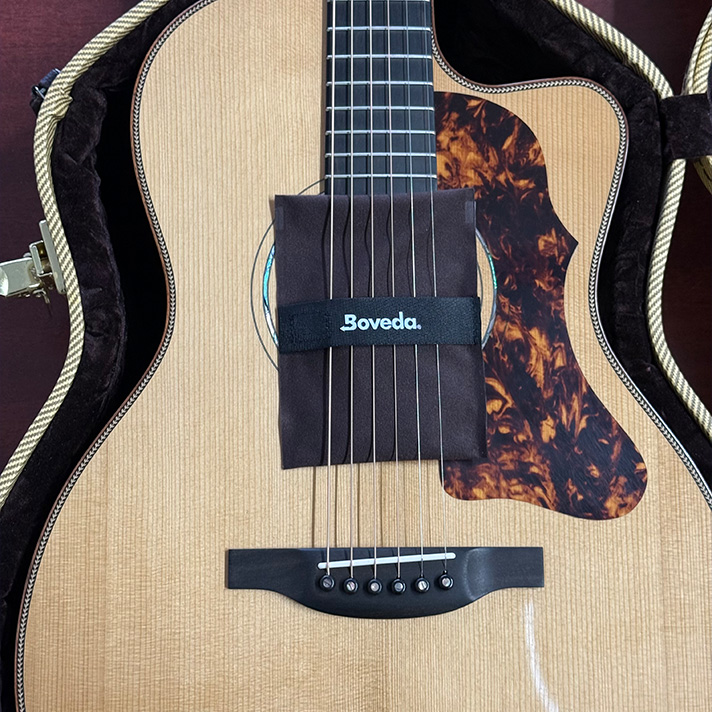
Every guitar is individually handcrafted over 12 weeks, each element hand chosen by the builder to match the soundboard and other components of the musician’s specifications. This sole luthier craftsmanship ensures each guitar meets Boucher’s high standards of quality, playability, and sound. For stability and ease of maintenance, Boucher integrates a bolt-reinforced neck joint. The guitar builder monitors each instrument’s evolution. When it’s ready to leave the workshop, the guitar is placed in a case with Boveda. During shipping, the Boveda packs ensures humidity protection for every guitar, so it arrives in top shape.
An interview with Boucher Guitars founder Robin Boucher about guitars and humidity
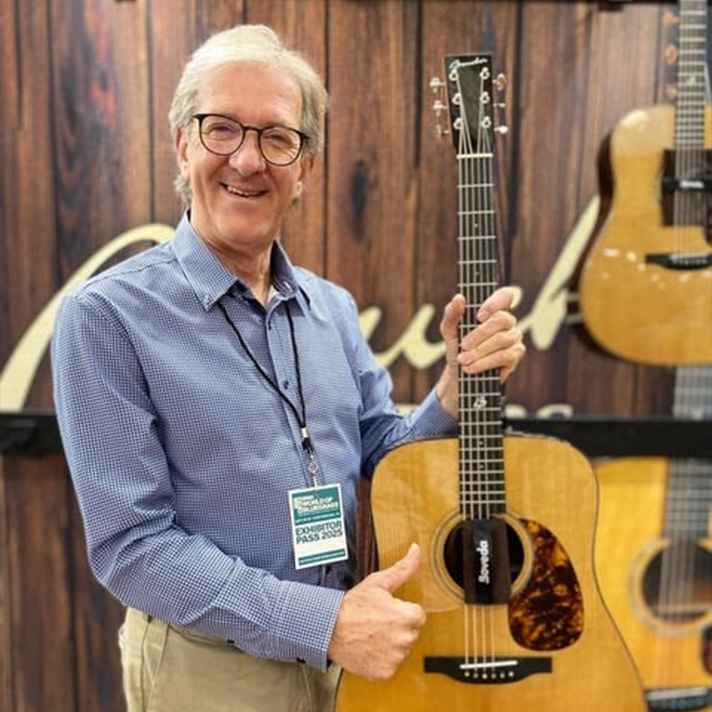
Why do you ship a Boucher guitar with Boveda inside the case?
First and foremost, it’s about protecting our guitars from major fluctuations in temperature and relative humidity that can occur during transit. Take January, for example: imagine the dramatic shifts a guitar might experience when shipped from Quebec and delivered just three or four days later in Singapore. As you may imagine, the contrast is huge! Thankfully, with Boveda, Boucher Guitars can ship guitars anywhere in the world, anytime, without a second thought.
The second reason, just as important, is to raise awareness among guitarists about the invisible threat that is humidity. It’s essential to understand how critical it is to control the relative humidity around your beloved instrument. In my opinion, the most effective and affordable way to protect your guitar from environmental stress is to always keep Boveda packs inside the case. As I often tell my fellow guitarists and clients: ‘Let’s only take our guitars out of their cases when we’re ready to play them!’
Unless you’re playing a guitar right now, it should always stay in its case, paired with Boveda humidity control. Your guitars deserve protection. Let them live long, sound great, and stay safe.
How do varying humidity levels affect guitar building?
Humidity plays a crucial role in both the construction and long-term health of a guitar because solid wood is a living material. It naturally absorbs and releases moisture depending on changes in the surrounding relative humidity. That means solid wood will expand in humid environments and contract in dry air. These movements can cause serious issues not just during the building process, but throughout the instrument’s entire life. We’re talking about potential warping of the soundboard or the back, cracks, neck distortion, loose braces, separated joints, and even lifting sides.
Too much humidity can dampen the wood’s resonance, shortening sustain and reducing projection. On the other side, overly dry air can make the tone harsher and less warm. In extreme dryness, the fretboard may shrink, exposing fret ends and affecting playability.
As guitar builders, we face many challenges when it comes to humidity. We work exclusively with stabilized tonewoods, ideally quartersawn to minimize movement. And we absolutely must build our guitars in a climate-controlled environment where relative humidity is kept between 40% and 50%, 24 hours a day, 365 days a year. Actually, one of the largest investments we’ve made at Boucher Guitars is in our sophisticated humidity control system. Managing humidity demands precision, foresight, and craftsmanship so that every guitar can resonate at its full potential, without warping or cracking.
Humidity plays a crucial role in both the construction and long-term health of a guitar because solid wood is a living material.
When selecting woods for guitars, do you consider the wood’s response to humidity changes?
In the world of guitar building, some solid wood species are rarely used or even deliberately avoided. Their reaction to changes in temperature and relative humidity can seriously affect the stability of the instrument, even if the wood has been carefully seasoned and well stabilized. This is especially true for certain tropical woods, which tend to respond much more dramatically to environmental shifts than commonly used tonewoods like South American mahogany or Indian rosewood. Those woods offer a natural stability that makes them more reliable in varying conditions.
Guitars made with more sensitive woods require extra care. They need to be kept in tightly controlled environments and maintaining them becomes a discipline in itself. As luthiers, we don’t choose woods just for their beauty. We also consider its tonal character, how well it ages, how it handles climate changes, and whether it can offer musicians a long-lasting, worry-free playing experience.
How do you mitigate the risks of humidity fluctuations while building guitars?
At Boucher Guitars, our fight against humidity-related risks starts long before the first piece is assembled. Every step of our building process is designed to preserve the stability and longevity of our instruments without ever compromising their acoustic performance.
It all begins with the wood
We use only premium tonewoods with an internal moisture content strictly maintained between 7% and 9%. Each piece is stored for at least one year in a climate-controlled environment where temperature and humidity are carefully regulated. That’s what we call stabilized wood, a critical foundation for building guitars that last.
For soundboards and bracing, we take it even further. We work exclusively with Adirondack red spruce, chosen not only for its legendary vibrational qualities but also for its superhero-like ratio of weight, density, and flexibility. Each soundboard comes from logs we personally select, freeze, and process right here at our facility in Berthier-sur-Mer.
Drying is done naturally, assisted by fans to ensure even airflow and consistent moisture release. And for select guitars, we use torrefaction. This thermal treatment, applied mainly to soundboards but also to few tonewoods like maple and South American mahogany, enhances the wood’s resistance to humidity fluctuations. By removing lignin, a natural component of wood, it improves climate stability while giving the guitar a unique tonal character.
How can guitar owners best protect their instruments long term?
- Never hang your beloved solid wood guitars on the walls of your home.
- Never leave them sitting in the trunk of your car in hot or cold weather.
- Unless you’re playing it right now, a guitar should always stay in the case, paired with Boveda for protection from humidity damage.